


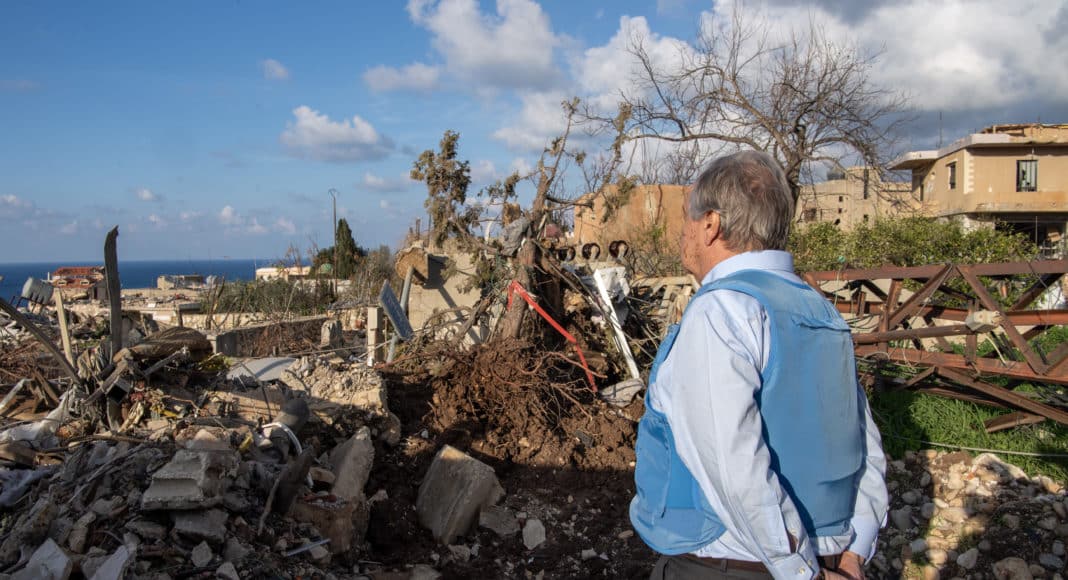

UN peacekeeping, like the UN as a whole, is experiencing a multidimensional crisis. This crisis raises questions about the adaptability and flexibility of peace operations to new realities, not only in New York but also in the field where they are deployed. It is in this context that the United Nations Interim Force in Lebanon (UNIFIL), deployed since 1978, has been confronted with violent upheavals in its area of operations (AO) in the wake of the 7 October 2023 attacks perpetrated in Israel by the Palestinian Hamas. The nature and duration of these developments significantly tested the mission’s flexibility and adaptability.
When we talk about the adaptability of peace operations, there are several levels to consider. At the global level, it refers to the adaptation of peacekeeping to an international context marked by geopolitical realignments, budget cuts, technological challenges and more complex local environments. At the mission level, it is often associated with the process of evolutionary change in response to transformations in the mission’s environment. When the change is structural, we tend to talk about adaptability. When the adjustments are more ad hoc and aimed at dealing with a particular situation, it is more a question of adaptation.
In the case of UNIFIL, against a backdrop of multiple questions surrounding peacekeeping, two dimensions emerged from autumn 2023 onwards: first, operational adaptation to navigate an increasingly volatile environment; then, in the post-acute crisis period, a more strategic and structural adaptation, but one whose focus on a few dimensions of the mandate places it in a kind of infra-adaptability.
Based on the upheavals that have been unfolding since 2023, this note analyses these two dimensions of UNIFIL’s adaptation to a succession of multifaceted challenges. It attempts to identify the factors that influence the mission’s adaptation process and modalities, while questioning their effectiveness and their contribution to peacekeeping.
The first section presents the situation in which UNIFIL operated before October 2023, highlighting its complexities. The following three sections focus on developments in the mission’s environment, the challenges this poses, and the adjustments it is making as a result for the periods from October 2023 to September 2024, the peak of the crisis (September to November 2024), and after the cessation of hostilities (after the end of November 2024). The fifth section provides a summary of the adaptations and analyses the factors that shaped them, while the sixth and final section analyses UNIFIL’s adaptations through the prism of reflections on peacekeeping that have been at the heart of UN debates for several years, raising crucial questions about the future of UN peacekeeping.
 Flexibility and adaptability of UN missions: UNIFIL between opportunities and contextual limitations
This content was originally published in French in February 2026. Please see Flexibilité et adaptabilité des missions de l’ONU : la FINUL entre opportunités et limites contextuelles
Elena AOUN est professeure et chercheure en relations internationales à l’Université catholique de Louvain et membre du Centre d’études des crises et des conflits internationaux (CECRI) et du groupe d’études et de recherches sur le Monde Arabe contemporain (GERMAC). Titulaire d’un doctorat en Etudes politiques de Sciences Po Paris (2007), elle a travaillé en thèse sur l’implication de l’Union européenne dans le processus de paix au Moyen-Orient. En 2008-2009, Elena Aoun a effectué un post-doctorat à l’Institut d’études européennes des Universités de Montréal et McGill. Ses recherches se sont alors focalisées sur la politique de l’Union européenne à l’égard de la justice pénale internationale et en particulier de la Cour pénale internationale.
Les recherches actuelles d’Elena Aoun se concentrent sur les crises du Moyen-Orient et la politique étrangère de l’UE à leur égard, avec une attention spéciale à la crise syrienne et ses multiples ramifications, y compris la dynamique transnationale du djihadisme de l’Etat islamique. Elle est également impliquée dans un projet ARC intitulé : « Resistance to international prescriptions and injunctions in Africa and the Middle East today » dans le cadre duquel elle travaille sur la résistance aux politiques du genre au Moyen-Orient. Elle collabore avec Thierry Kellner (ULB, GRIP) sur les stratégies des puissances émergentes à l’égard du Moyen-Orient et avec Didier Leroy (ULB – ERM) sur un projet portant sur la participation d’acteurs libanais non-étatiques au conflit en Syrie.