





Since 1993, the UN has been involved in Haiti through a succession of missions with mixed results: real tactical progress, but also severe trauma and a failure to address the root causes of the security crisis, primarily corruption and the weakness of the judicial system. The assassination of President Jovenel Moïse in July 2021 revealed the extent to which the Haitian state had been infiltrated by criminal elements and ushered in a period of transition marked by escalating violence. Organising the forthcoming general elections, with the first round scheduled for 13 December 2026 – in accordance with the electoral decree of 2 July of the same year – presents a challenge; no elections have been held for 10 years and the country no longer has any elected representatives.
In 2023, Resolution 2699 established the Multinational Security Support Mission (MMAS), a police force capped at 2,500 personnel. Its results fell far short of expectations: fewer than 1,000 police officers deployed, a disproportionately high annual budget, and an overly restrictive mandate. The MMAS failed to prevent the humanitarian and security crisis from worsening.
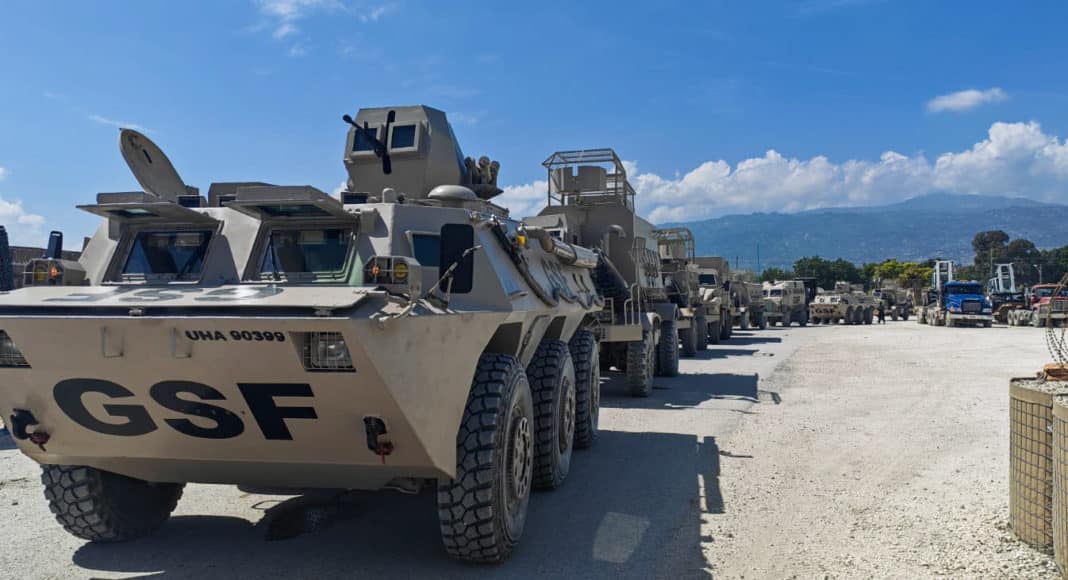
On 30 September 2025, Resolution 2793 formalised the transformation of the MMAS into a significantly more robust and proactive force, the Gang Suppression Force (GSF). Unlike the MMAS, the FRG is authorised to conduct autonomous anti-gang operations and, as it is not a UN operation, it is not bound by peacekeeping rules, thereby having a particularly robust and offensive mandate. This resolution simultaneously established the United Nations Support Office in Haiti (UNSOH), responsible for providing logistical support to the FRG. Since 1 April 2026, these missions have co-existed alongside the United Nations Integrated Office in Haiti (BINUH), a political mission in place since 2019. The result is an unprecedented « three-pronged » structure: BINUH (political component), UNSOH (logistical support) and the FRG (military component), each with its own chain of command.
This note identifies three levels of challenges for the success of this new structure. Firstly, a test among the Haitian population, whose acceptance will depend on concrete and rapid results (the return of residents to their neighbourhoods, the holding of elections as scheduled in the electoral calendar of 26 July 2025) and the proper conduct of the deployed troops. Secondly, an internal test within the UN, requiring close coordination between BINUH, UNSOH and the FRG to avoid duplication and ensure the coherence of UN action.
Finally, a political test in the Security Council when the FRG’s mandate is up for renewal at the end Of September 2026. The success of this tripartite framework, and considerations regarding the possible replication of this model in other theatres of operation, will depend on the outcome of these three tests.


This content was originally published in French. Please see « La Force de répression des gangs en Haïti, dernier avatar du Conseil de sécurité de l’ONU«
Bertrand Ollivier est chercheur affilié au Centre Thucydide de l'Université Paris II Panthéon-Assas et chercheur associé à l'Observatoire Boutros-Ghali du maintien de la paix depuis 2021. Ses recherches mêlent travaux académiques et retours d'expérience, en particulier sur le Sahel ou il a travaillé comme analyste pour la MINUSMA, chercheur à l'ONUDC et spécialiste à la Direction des affaires politiques de l'OIF. Il est désormais Conseiller politique en ambassade